Triptych (1984): An Artist’s Reflection
About my painting Triptych in the collection of The Museum of Fine Arts, Houston

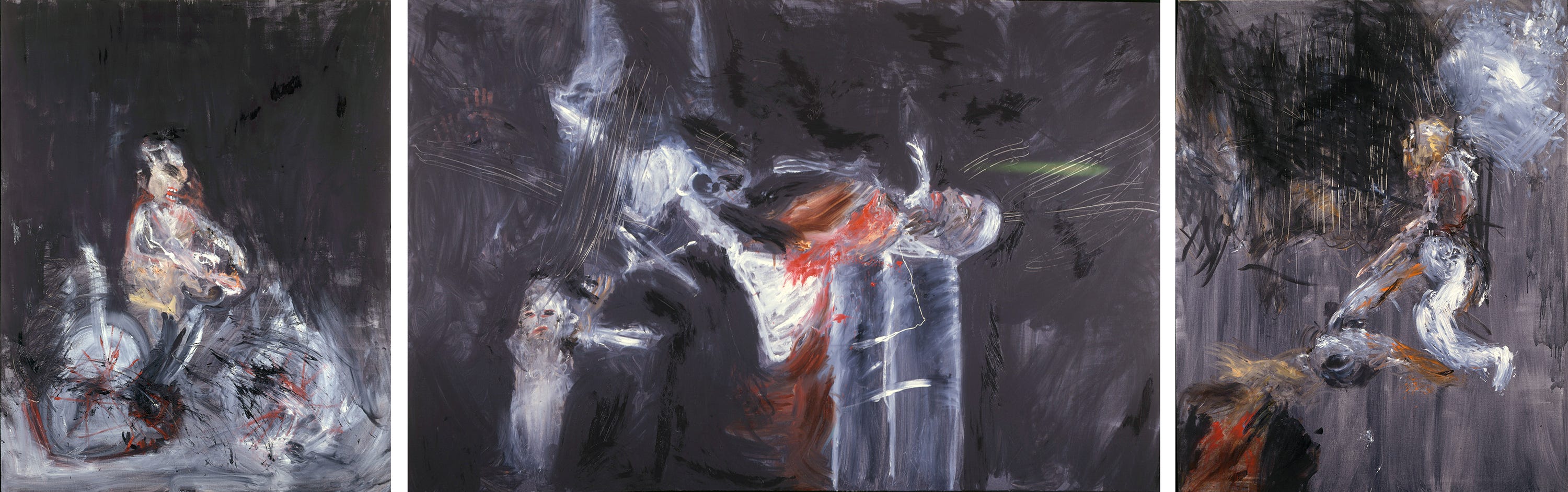
Triptych (1984): An Artist’s Reflection
When people ask me what Triptych is about, I tell them something about a motorcycle accident. It’s not untrue, but it’s not the whole truth either. The real answer is harder to articulate because I talk in images, not words. This painting is one of those images, a thought that could only happen in paint.
Beginning with Chaos
I created Triptych in 1984, working without models, without plans, without any predetermined idea of what it would become. The process began with a grey wash applied across three large canvases. I let it settle, allowed it to pool and drip and create its own logic. Then I looked. Really looked. The way you might stare at coffee stains on a tablecloth or debris patterns on a beach until faces emerge, until bodies appear in the randomness.
The grey wash suggested things, a figure here, a gesture there, movement caught mid-trajectory. My job was to see what was already latent in those accidental marks and bring it forward. I used black paint as my excavating tool, not to cover but to reveal. Each stroke was a decision about what to make visible, what to leave ambiguous, where the boundary between figure and ground should dissolve.
This is how I’ve always worked best: in conversation with accident, with the material’s own desires, with what wants to emerge rather than what I think should be there.
The Image That Appeared
What came forth across those three panels was a scene of bodies in extremis. In the central panel, a figure thrown back, mouth open, whether in scream or gasp I couldn’t say. Orange-red flesh against cooling greys and blues. White paint slashing diagonally across the surface, describing speed, impact, the violence of sudden change. The body caught between falling and rising, in that suspended instant before physics delivers its verdict.
The flanking panels present figures compressed into themselves, surrounded by swirling marks that suggest both motion and entrapment. On the left, a seated or crouching form. On the right, another body folded into dark space, orange and white tracing what might be limbs or might be the path of movement itself, ghost trails of catastrophe.
Is it a motorcycle accident? Perhaps. But it’s also any moment when the body betrays us, when control surrenders to velocity and chance. It’s the landscape of trauma, shock, physical extremity. The moment when we’re most violently, undeniably material.
Scale and Ambition
This was one of my earliest major paintings and certainly one of my largest. There was a fearlessness in working at this scale without preparation, without studies. Each stroke was a commitment. The size meant I couldn’t see the whole thing while I was painting it, I had to trust the process, trust that the conversation between my hand and the canvas would resolve into something coherent.
The triptych format gave it a ceremonial weight, though I wasn’t thinking about altarpieces or religious art when I made it. The three panels simply felt right, a way to fragment the moment of crisis, to make the viewer’s eye travel and work to assemble what happened. Trauma isn’t experienced all at once in neat composition. It’s fragmented, disorienting, reassembled later if at all.
Journey and Recognition
The late Ed Broida saw something in this painting. He was working on creating a museum in New York and selected Triptych for the lobby, the first thing visitors would encounter. He understood, I think, that it was a threshold work, something that prepares you for the intensity of looking that art demands.
Those plans were derailed by issues with city regulations, bureaucratic obstacles I never fully understood. But before his death, Ed donated the painting to the Houston Museum of Fine Arts, where it was exhibited and remains today. There’s something fitting about that, a painting born from spontaneity and accident finding its permanent home through a path neither of us anticipated.
Why It Matters to Me
Looking at Triptych now, forty years later, I see it as evidence of a way of working I’ve continued to trust: the intelligence of improvisation, the wisdom of accident, the truth that emerges when you stop trying to control the image and start listening to what it wants to become.
In a culture obsessed with planning, with digital precision, with predetermined outcomes, this painting represents another way of knowing. The grey wash that began it, the stains that suggested forms, the black paint that brought them forth, these weren’t techniques in service of an idea I already had. They were the thinking itself, happening in real time, in material, through the conversation between my hand and what appeared before me.
I didn’t invent these figures. I found them. They were always there in the grey, waiting to be seen.
Speaking Without Words
The motorcycle accident I mention when people ask, it’s a courtesy, a way to give language something to hold onto. But the real content of this painting exists outside language. It’s about bodies, yes. About crisis and impact and that terrible beauty that appears in moments of extremity. But more fundamentally, it’s about what it means to make images when you don’t think in words, when your intelligence moves through your hands, when you trust accident over intention.
Triptych taught me that some of my most important work would come from exactly this kind of surrender, not to chaos, but to a different kind of order, one that reveals itself only in the making. The grey wash knows things I don’t. The accidental drip has its own logic. My job is to pay attention, to bring forward what wants to be seen, to trust that the conversation between control and surrender will yield something I couldn’t have planned.
Forty years on, it still speaks in that language only images can articulate, urgent, immediate, undeniable. A collision frozen across three panels. A moment of impact that continues to reverberate.
This is what I mean when I say I talk in images. This is what I was trying to say.